
Article · Heroes and squads
Hero skills: who hits who, when, and how hard?
What really happens when the fighting starts: when each skill fires, who your heroes aim at, and the four shapes a skill can hit. Pictures included.
Published · 9 min read
You've built your squad, put your Tanks up front and your Carries behind them. But what actually happens when the fighting starts?
Your heroes don't just stand there trading punches. They have different attacks, skills, cooldowns and targeting rules. Understanding them makes a big difference to how you build your squad and where you put your heroes.
Understanding hero skills
Picture a fight in an action film.
- Auto Attack: the regular punches. Your hero keeps attacking all fight long.
- Active Skill: a heavy kick, or throwing someone into a wall. A bigger move that comes round every few seconds.
- Ultimate Skill: the big finishing move. The most powerful thing your hero does, and the longest wait.
- Passive Skill: the fighter's natural gifts. Maybe they're extra tough, hit harder when hurt, or grow stronger as the fight goes on.
The important difference: Auto Attack, Active Skill and Ultimate Skill are things your hero does. A Passive Skill just works on its own whenever its conditions are met. It might raise damage for the whole fight, kick in when an enemy hits, or add a bonus when your hero uses another skill. You never have to set it off yourself.
Timing: when do skills fire?
Skills run on cooldowns: the wait before a hero can use a skill again. Every skill also has a first wait at the start of the fight, before it can be used at all.
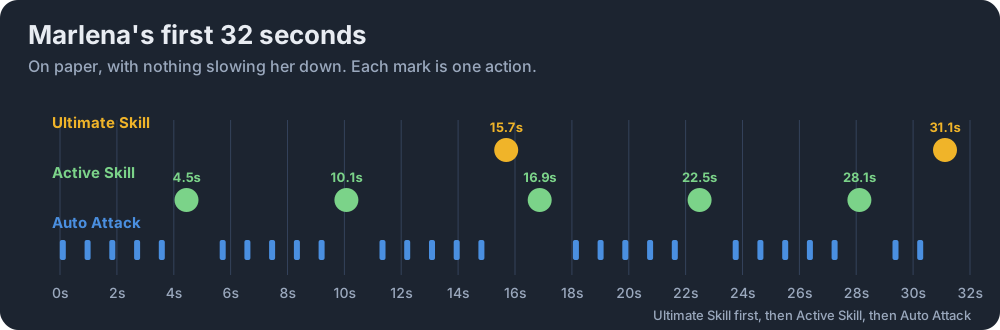
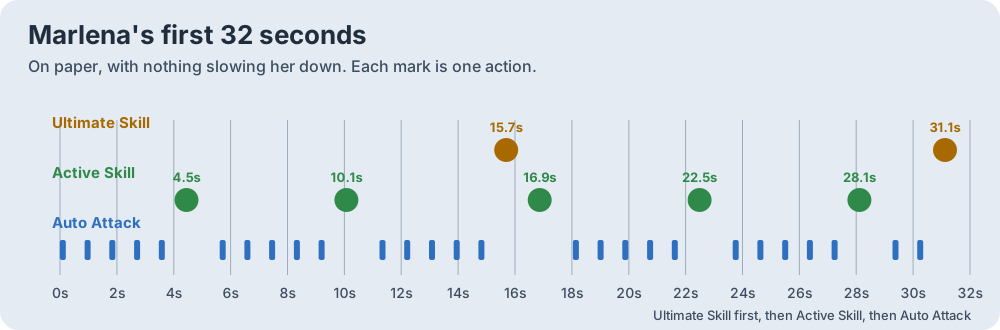
Let's take Marlena, with her real numbers:
- Auto Attack: about every 0.9 seconds.
- Active Skill (Crimson Bloom): first ready at 4 seconds, then every 5 seconds.
- Ultimate Skill (Peerless Blade): first ready at 15 seconds, then every 15 seconds.
Here's how her first 32 seconds play out, if nothing stops her:
A few things stand out:
- Skills wait for the hero's next turn. Her Active Skill is ready at 4 seconds, but she's partway through an Auto Attack, so it goes off at about 4.5 seconds instead. Those little delays add up over a fight.
- A big skill takes a moment. After her Active Skill or Ultimate Skill, she needs a little over a second before she can act again.
- When two are ready, the Ultimate Skill goes first. At 15 seconds both her Ultimate Skill and her Active Skill are waiting. She uses the Ultimate Skill, and the Active Skill follows on her next turn.
Every hero has their own timings. Many Carries open their Ultimate Skill at 15 seconds, but plenty of Tanks are much quicker: Arthur's Ultimate Skill is ready at 7 seconds and comes back every 7.
So your hero's damage isn't steady. It's a stream of Auto Attacks with bigger bursts when their Active Skill and Ultimate Skill land. And those bursts hit even harder when another hero's buff is running at the right moment.
Targeting: who does your hero attack?
Now it gets interesting. Your heroes don't attack whoever you'd like them to. They go for the closest enemy, and they stick with that enemy until it dies.
In a standard formation you have two heroes in front and three behind. Let's call yours B1 to B5 (blue, on the left) and the enemy's R1 to R5 (red, on the right):
- B1 and B2 are your front row. B3, B4 and B5 are your back row.
- R1 and R2 are the enemy's front row. R3, R4 and R5 are their back row.
Round 1, from where everyone stands at the start, the closest enemies work out like this:
- B1 goes for R1.
- B2 goes for R2.
- B3 goes for R1.
- B4 goes for R1 (R1 and R2 are just as close, and the lower number wins).
- B5 goes for R2.
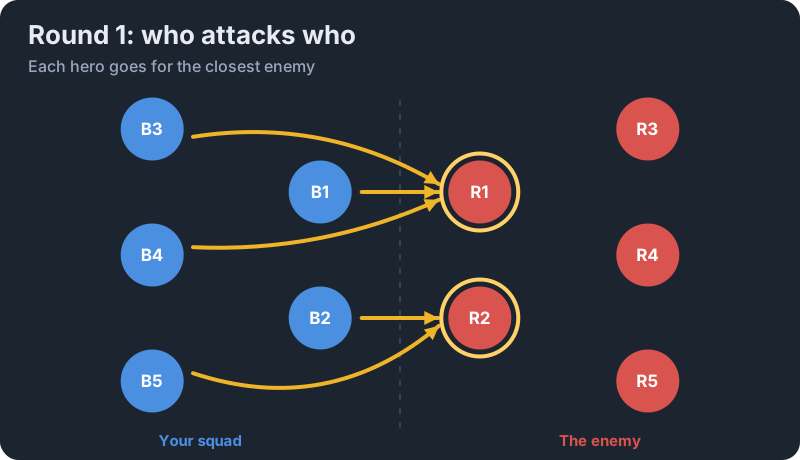
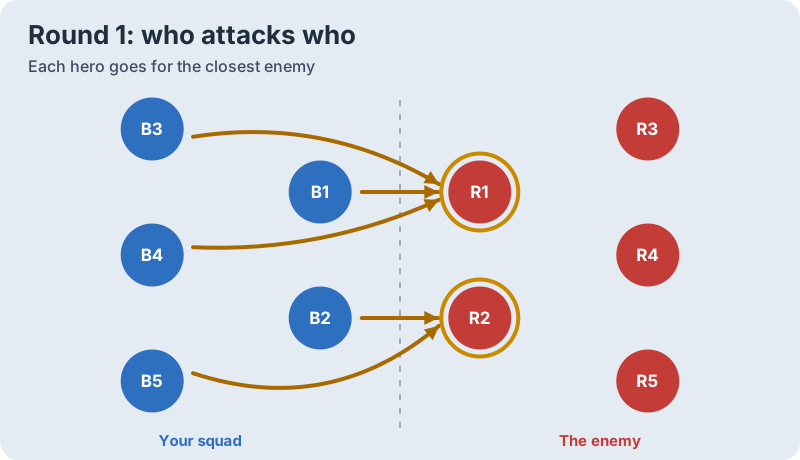
The enemy does the same to you. So position 1 starts the fight with three heroes hitting it, and position 2 with two.
That's why your toughest Tank belongs in position 1.
What happens when a Tank falls?
Think of a fight in rounds. A new round starts whenever a target dies and everyone who was hitting it picks again, always the closest enemy left.
Round 1: the opening
That's the picture above. Three of your heroes are on R1 and two are on R2.
Round 2: R1 goes down
B1, B3 and B4 need a new target, and the closest one left is R2. So R2 isn't facing two attackers any more. It's facing all five.
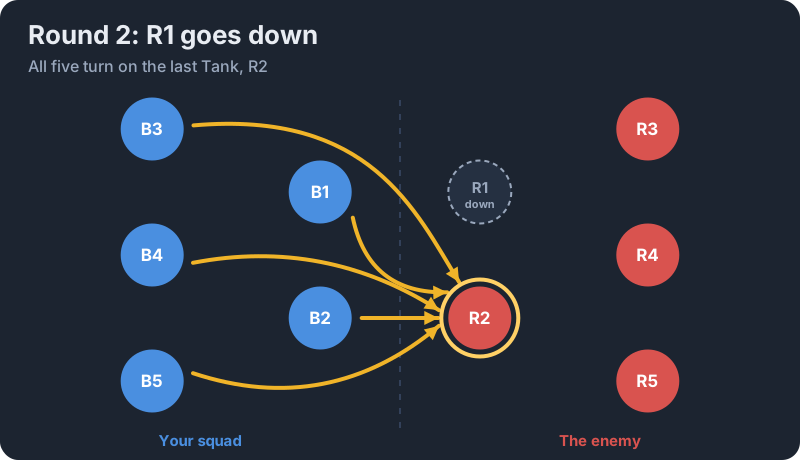
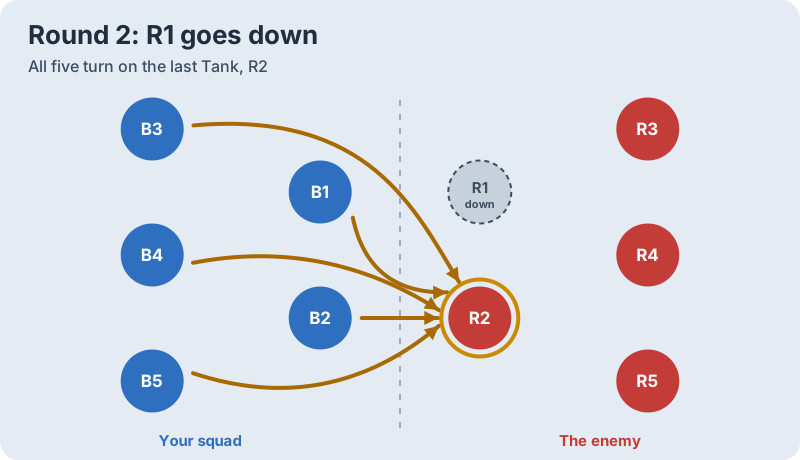
Round 3: R2 goes down
Now the enemy's front row is gone, and everyone picks the closest enemy again. With nobody left in front of them, your Tanks run up to the enemy's back row and fight up close.
Your back row is lined up straight across from theirs, so the enemy directly opposite is the closest: B3 goes for R3, B4 for R4 and B5 for R5. Your Tanks join in: B1 on R3 and B2 on R4.
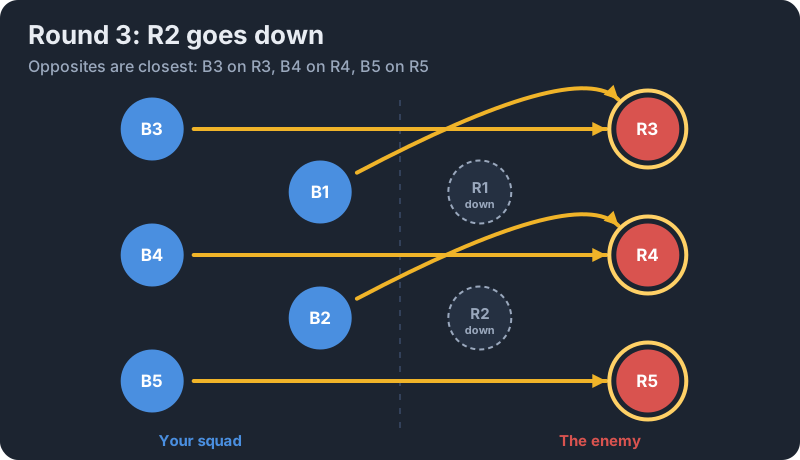
Now their Carries are taking the hits. Remember, Carries have less HP and DEF. They aren't built to take that kind of punishment, and once a front row collapses, the damage dealers behind it can vanish very quickly.
It works the same way against you. Lose your B1 Tank and all five enemies turn on B2. Lose B2 too and your back row is wide open. That's how a fight suddenly swings, so keep your Tanks standing longer than theirs.
The four shapes a skill can hit
This is where it gets really interesting. Not every attack goes for the hero's own target. Every skill has a shape, and the shape decides who gets hit.
1. Direct
The skill hits one enemy: the one your hero is already attacking. Almost every Auto Attack works this way.
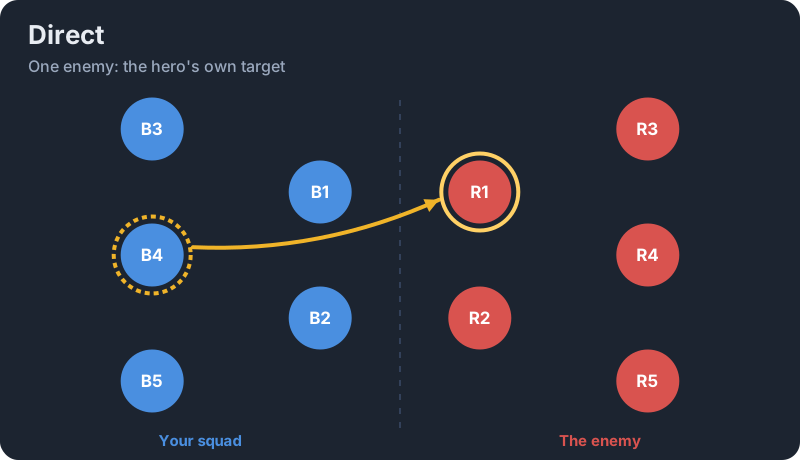
Direct hits are great for focusing damage and bringing enemies down one at a time. But they only ever hit whoever's closest, which usually means the enemy's Tank.
2. Random
The skill picks its targets at random. Marlena's Ultimate Skill, Peerless Blade, sends out 3 sword winds, each at a random enemy.
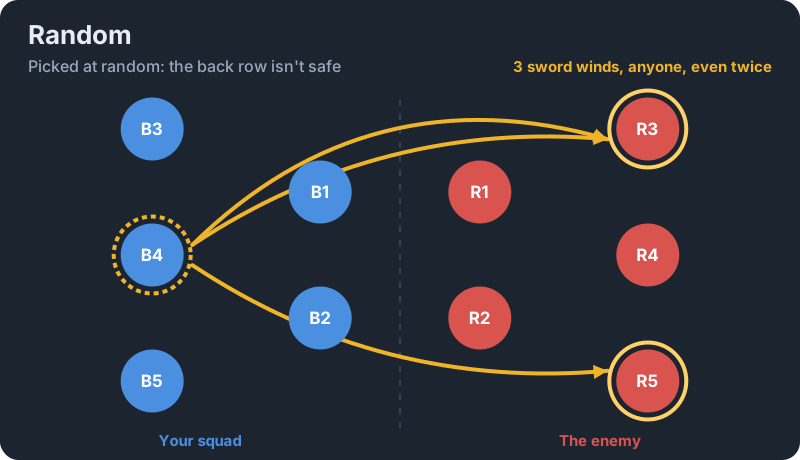
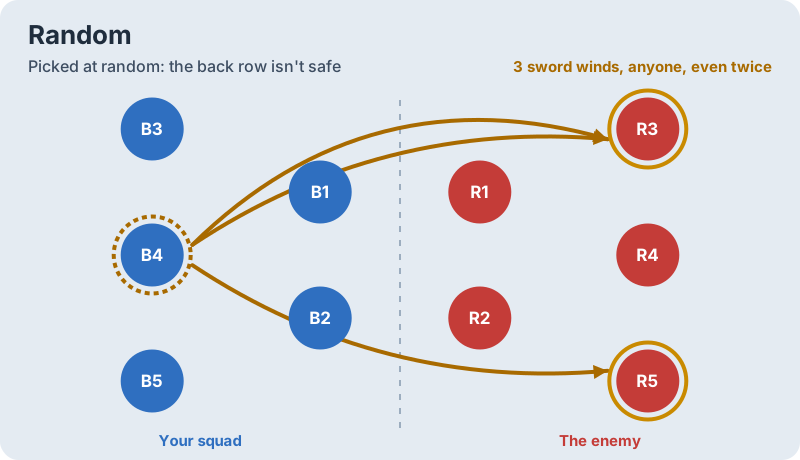
They don't aim for the front row. They can land on the back row, spread across three enemies, or hit the same one more than once. That makes random skills a way to hurt the enemy's Carries before their Tanks fall. The catch: you can't choose who gets hit.
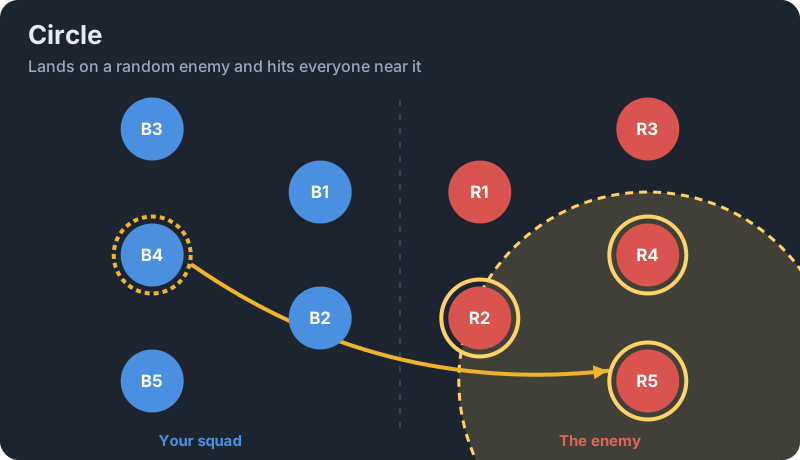
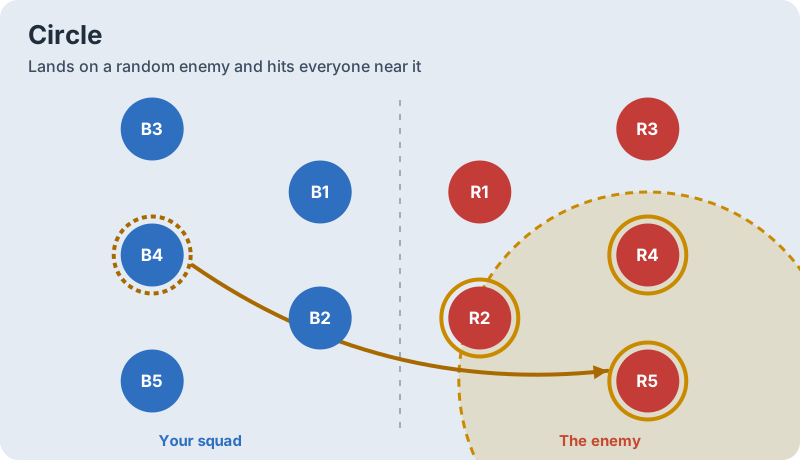
3. Circle
The skill lands on an enemy and hits everyone within a circle around it. Here's the part most people don't know: the circle usually lands on a random enemy, not on the one your hero is attacking.
Marlena's Crimson Bloom has a big circle. Wherever it lands, it catches at least three enemies, and if it lands in the middle of their back row, all five. Others, like Annie's and Grenwald's, are much smaller. Don't assume a circle hits everyone: its size decides that.
Some circles sit around the hero instead. Arthur's Ultimate Skill hits every enemy close to him.
4. Square
The skill hits a long strip running from your hero, through their target and beyond. Shadow's Active Skill hits everything in a strip 750 long and 200 wide.
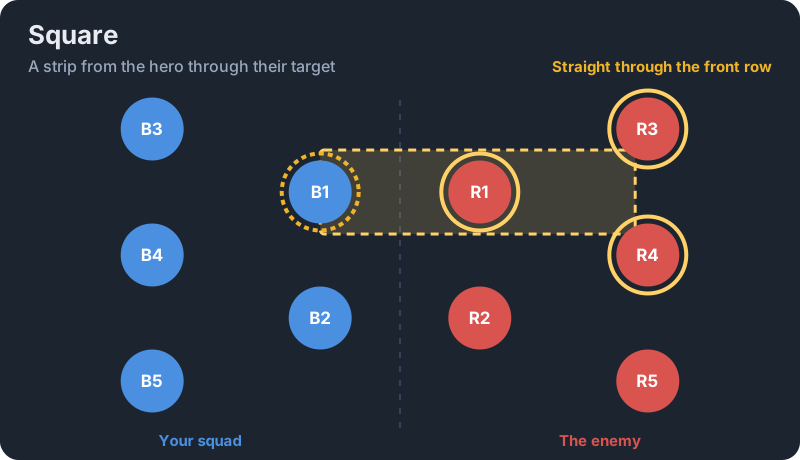
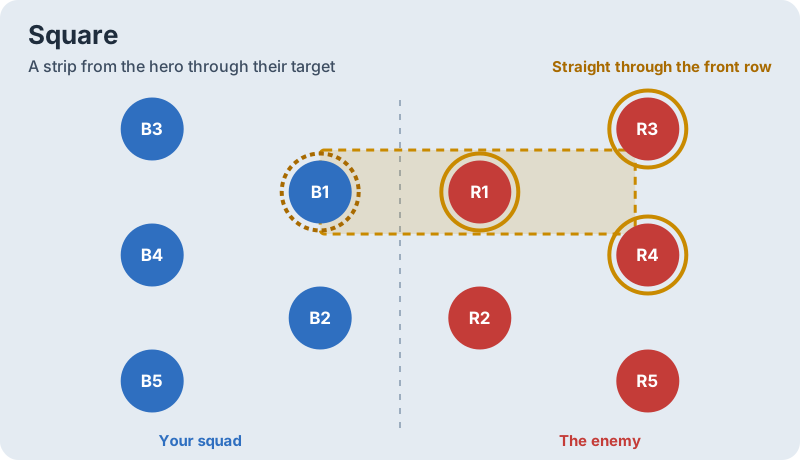
A strip from the front row goes straight through the enemy's front row and can catch the back row behind it.
There's one more shape you'll see on Tanks: a fan in front of the hero. Bella, Billy, Durant, Hastar and Louis all have one. It hits everyone in a wedge in front of them, so it's great when the enemy bunches up close.
Skills with their own targets
Some skills ignore the closest enemy and the shapes altogether, and pick by a rule of their own:
- The enemy with the lowest HP: Joker goes after whoever's nearly dead.
- The enemies with the highest ATK: Annie's and Red Lady's Ultimate Skills go straight for the 2 biggest hitters, which usually means your Carries.
- A number of random enemies, like Marlena's sword winds.
That's why two Carries with similar ATK can do very different jobs. One spends the fight chipping at a heavily armoured Tank. The other has a skill that reaches the enemy's soft back row.
Read the skill description. The targeting rule matters as much as the damage number.
Why targeting matters
Imagine you're fighting a squad with two powerful Tanks and three dangerous Carries.
Your Auto Attacks are hitting the Tanks. That's fine: your squad needs to get through them.
But say one of your heroes has a circle that keeps landing on their back row, and another has a skill that goes for the lowest HP. Those skills start hurting the enemy's Carries while their Tanks are still standing.
That's a big advantage. You're no longer relying only on breaking through the front row to hurt the heroes doing the damage.
It's one more reason to look beyond ATK when you compare Carries. A hero with a bit less ATK but better targeting may do more in the fight that matters.
Skills work together
Now add a Support who raises your squad's ATK.
If that buff is running when Marlena fires her Ultimate Skill, the Ultimate Skill hits a lot harder. If it runs out just before, she misses out.
Timing matters. So does survival. A Tank who lasts another five seconds might give your Carry time for one more Active Skill. A Support whose buff lands at the right moment might help your Carries bring down their Tank before yours falls.
That's why a squad isn't just five heroes. It's five heroes whose skills need to work together.
Getting more from your skills
- Read the targeting. Don't just look at the damage number. Find out who the skill actually hits.
- Watch your Tanks. If they fall before your Carries use their big skills, your front row needs attention.
- Look for random, circle and strip skills. Anything that reaches past the Tanks is worth a lot.
- Don't judge a hero by ATK alone. Cooldowns, effects, targets and survival all change how much damage they really deal.
- Try different positions. Moving heroes changes who takes the first hits and how long your damage dealers survive.